Overview
A generative AI document assistant designed to help users navigate lengthy mortgage documents, retrieve relevant information, and ask questions using natural language.
Role: AI Engineer
Timeline: August – October 2025
Organization: Extern (Outamation)
Tools: Python, LlamaIndex, RAG, ChromaDB, BM25, OCR, PyMuPDF, Gradio
The Challenge
Mortgage documents can span hundreds of pages and contain important information distributed across multiple sections. Finding a specific detail through manual reading can be time-consuming and difficult.
The challenge was to create a document experience that made relevant information easier to find while preserving the context needed to understand the source material.
The Solution
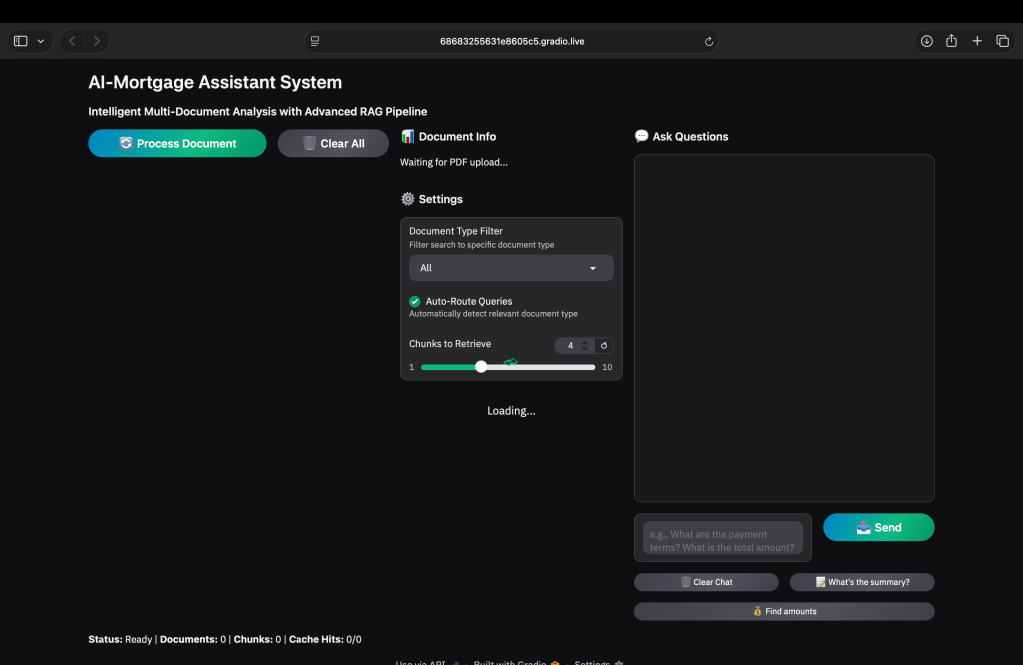
I contributed to an AI-powered document assistant that combined document processing, retrieval, and language-model capabilities to help users explore mortgage documents.
The workflow included:
- Uploading and processing PDF documents.
- Extracting text from scanned and digital documents.
- Organizing content into searchable chunks with metadata.
- Retrieving relevant passages through semantic and keyword search.
- Using retrieved context to generate responses to user questions.
Designing the experience
The experience was organized around a simple user journey:
- Upload: Provide a mortgage document for processing.
- Ask: Enter a natural-language question about the document.
- Retrieve: Find relevant passages using hybrid search and metadata filtering.
- Understand: Receive an AI-generated response grounded in the retrieved content.
- Explore: Use the answer as a starting point to investigate the source document further.
The goal was to reduce the effort required to locate information without making users navigate the underlying technical complexity.
Technical Approach
The assistant used a Retrieval-Augmented Generation (RAG) pipeline to connect document content with AI-generated responses.
- Document processing: Used OCR and PDF parsing to extract text from long mortgage documents.
- Chunking and metadata: Structured document content for retrieval and contextual organization.
- Hybrid retrieval: Combined vector search with BM25 keyword search to retrieve relevant passages.
- Contextual generation: Used retrieved content to inform model responses.
- Application interface: Connected the workflow through an interactive Gradio application.
Key Design Considerations
- Make the question-and-answer interaction straightforward and approachable.
- Preserve document context when retrieving information.
- Handle long documents through structured processing and retrieval.
- Balance answer usefulness with the need to remain grounded in source material.
What I learned
This project strengthened my understanding of designing AI-powered experiences where users need to find and interpret information rather than simply receive generated text.
It also reinforced the importance of connecting interface decisions with the underlying AI system: retrieval quality, document structure, and context directly shape the user experience.
